
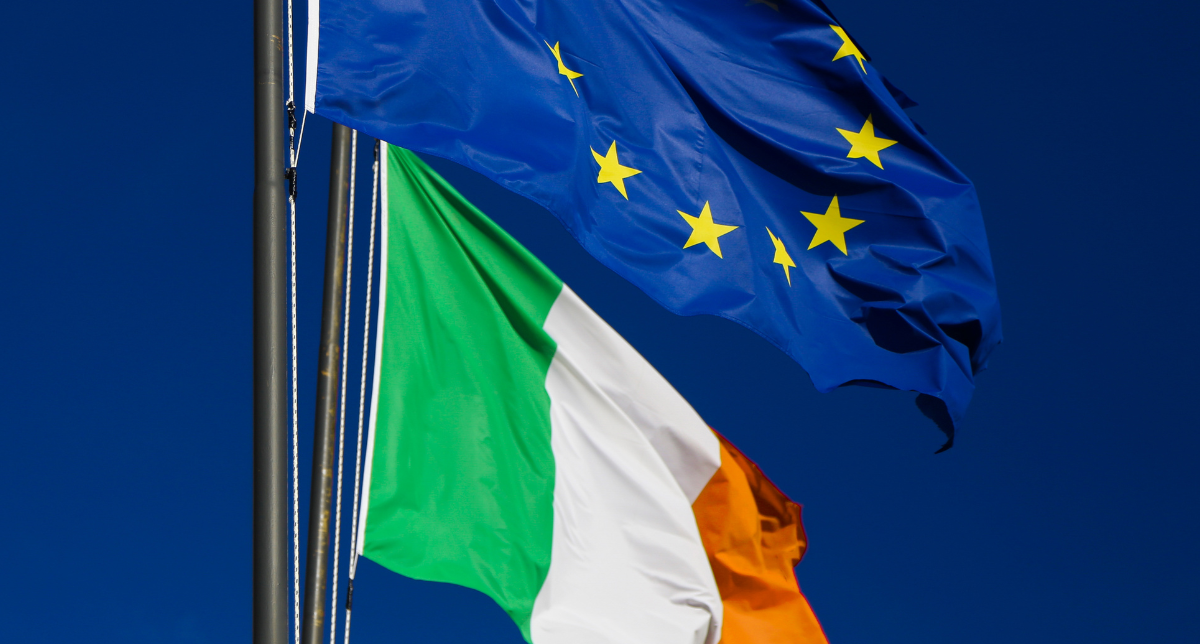
Ireland’s EU Presidency 2026: Priorities, Pressures and Policy Direction
The Irish Government has published its priorities for Ireland’s Presidency of the Council of the European Union, which will commence in July. These priorities will act as the north star, guiding how Ireland steers negotiations, builds consensus among Member States and advances key legislative files across the Union.
 Insight
While the rotating Presidency is often seen as a diplomatic function, it also offers a significant opportunity to shape the direction of EU policymaking at a critical moment for the Union. Geopolitical uncertainty feeds into a strained background, from EU–US tensions to the war in Ukraine and instability in the Middle East, feeding through into energy markets, supply chains and industrial competitiveness.
Against this context, Ireland has centred its Presidency on three interlinked pillars: competitiveness, values and security, with the next Multiannual Financial Framework (2028–2034) running across all three as a defining framework for EU priorities.
Ireland has long drawn on its tradition of neutrality to position itself as a consensus-builder and “honest broker”, a role reflected in its motto ‘Ní neart go cur le Chéile.’ This approach is now being tested by a more fragmented global environment. Ireland’s ability to bridge divides is increasingly under pressure amid disagreement on issues such as a multi-speed Europe, the conflict in the Middle East, and EU–US relations, dynamics that are making consensus harder to secure.
Simplification & Competitiveness
Drawing on the Letta and Draghi reports, the Presidency places European competitiveness and regulatory simplification at its centre.
Ireland has committed to advancing the EU’s Omnibus Simplification Packages across key sectors, including digital regulation, environmental law, automotive standards, and food and feed safety, aiming for agreement with the European Parliament by the end of 2026.
Measures to strengthen competitiveness will be advanced, including tax simplification initiatives and capital markets reforms under the Savings and Investments Union. Discussions will focus on the European Competitiveness Fund and the next generation of EU research and innovation programmes, with the MFF set to be advanced into 2027.
Security & Defence
Security and defence are significant talking points of the Presidency, reflecting the growing impact of hybrid and cyber threats across Europe. Ireland will support the European Security Strategy and the Defence Readiness Roadmap 2030, alongside reforms to defence procurement and military mobility to strengthen the EU’s ability to plan, invest and respond together more effectively.
Europe’s day-to-day security and resilience will also be addressed, including countering hybrid threats, protecting critical infrastructure, and improving crisis preparedness. Maritime security is of particular importance for Ireland with significant undersea energy and data cable infrastructure off the West coast linking directly into Europe’s wider communications and energy systems.
Alongside this agenda, Ireland will manage operational security considerations, with the Government keen to avoid any mishaps as it prepares for the Ninth Summit of the European Political Community in November.
Digital
The digital transition will feature heavily across the Programme. The substantial legislative agenda includes the Cloud and AI Development Act, the Digital Networks Act, the Digital Simplification Omnibus, and the European Business Wallet. Ireland has also set an ambitious objective of securing agreement with the European Parliament on the Digital Omnibus package by the end of 2026.
AI governance will be a central focus, with a dedicated AI Summit aimed at supporting responsible deployment while enabling wider economic adoption.
Regulation, including child online safety, age verification and the Digital Services Act will be a key policy area. Public pressure for increased regulation will create a difficult balancing act given Ireland’s position as a European base for major tech companies. Ireland will be keen to progress legislation alongside other Member States rather than doing it alone.
Health
The priorities reflect a growing belief that strong health systems are a cornerstone of Europe's economic resilience, competitiveness and security. As Europe seeks to reduce reliance on non-EU suppliers, strengthen supply chain resilience and support pharmaceutical innovation, the Presidency will advance several major legislative files, including the Biotech Act, the Pharmaceutical Package, and simplification measures for the Medical Devices Regulation (MDR) and In Vitro Diagnostics Regulation (IVDR).
Ireland will also prioritise implementation of the European Health Data Space (EHDS) and progress the Critical Medicines Act, which aims to address medicine shortages and strengthen security of supply. Alongside these legislative priorities, the Presidency will focus on the need for a resilient EU healthcare system post COVID.
Energy
As geopolitical instability continues, energy will be a central theme. Ireland has committed to advancing the European Grids Package, supporting investment in clean energy infrastructure and accelerating electrification across the Union. The Presidency will support efforts to simplify permitting processes and remove barriers to strategic energy projects, recognising that delivering the green transition depends on the rapid deployment of the infrastructure needed to power Europe’s future.
It is becoming increasingly complex to sustain the balance between climate ambition, energy security and industrial competitiveness. These priorities are now more tightly interlinked, requiring delivery across all three in a fast-moving geopolitical and economic environment.
Climate & Sustainability
Ireland’s Presidency comes at a pivotal moment for European climate policy with an ambitious sustainability agenda alongside growing political divisions among Member States. The EU Emissions Trading System is a central point of contention. Several EU governments, led by Italy, have called for the ETS to be frozen, arguing it places an additional burden on European businesses and contributes to higher electricity costs.
Ireland will navigate a delicate balance, advancing ETS reform and wider carbon pricing safeguards including the Carbon Border Adjustment Mechanism, while maintaining support among Member States with increasingly contrasting views on the Green Transition. The Presidency will also advance key files including the Circular Economy Act, the Environmental Simplification Omnibus, and the European Water Resilience Strategy.
Oisín Johnston
Across Ireland’s Presidency programme, with 22 informal ministerial meetings and over 250 conferences and meetings, there is ample opportunity to engage directly as EU policy is shaped in real time. Get in touch to discuss how we can help your organisation to engage so that you won’t just be heard, you’ll be understood.